
What Another Season of Waiting Actually Costs
Every storm season that passes without addressing your garage door's wind resistance is a bet against the odds, and in Southwest Florida those odds shorten every year. A door that fails during high wind doesn't just mean a repair bill. Once wind gets inside a garage, it pushes up against the roof decking from underneath, and that's how homes lose roofs in a storm that otherwise would have held. The difference between a door that holds and one that doesn't can be the difference between cleaning up storm debris and rebuilding a section of your house.
Why the Garage Door Is the Weakest Wall in the House
Every other exterior wall in a typical home is a continuous, braced structure: studs, sheathing, and a top and bottom plate all tied together. A garage door opening breaks that chain. It's the single largest unsupported span in the exterior envelope, held in place by a track system, rollers, and whatever gauge of steel or aluminum the panels are made from.
When wind hits a closed house, pressure builds on the windward side and tries to escape wherever it can. A garage door that isn't rated for wind load can bow, pop off its tracks, or blow in entirely under sustained gusts well below what older building codes anticipated. Once that door fails, the wind pressure inside the structure has nowhere to go but up, and uplift on the roof system increases dramatically. This is why wind-load-rated garage doors exist as a distinct product category in hurricane-prone areas, and why insurers and contractors treat the garage door as structural, not cosmetic.
Signs Your Door Won't Hold Up
- Visible flex or oil-canning in the panels when the door is closed and a stiff breeze hits it — thin steel will ripple before it fails outright.
- Rust at the bottom corners or along the track, which is common near the coast where salt air accelerates corrosion and weakens the metal faster than inland homes experience.
- Tracks that aren't lagged into solid framing, or that show gaps between the track and the wall when the door is cycled.
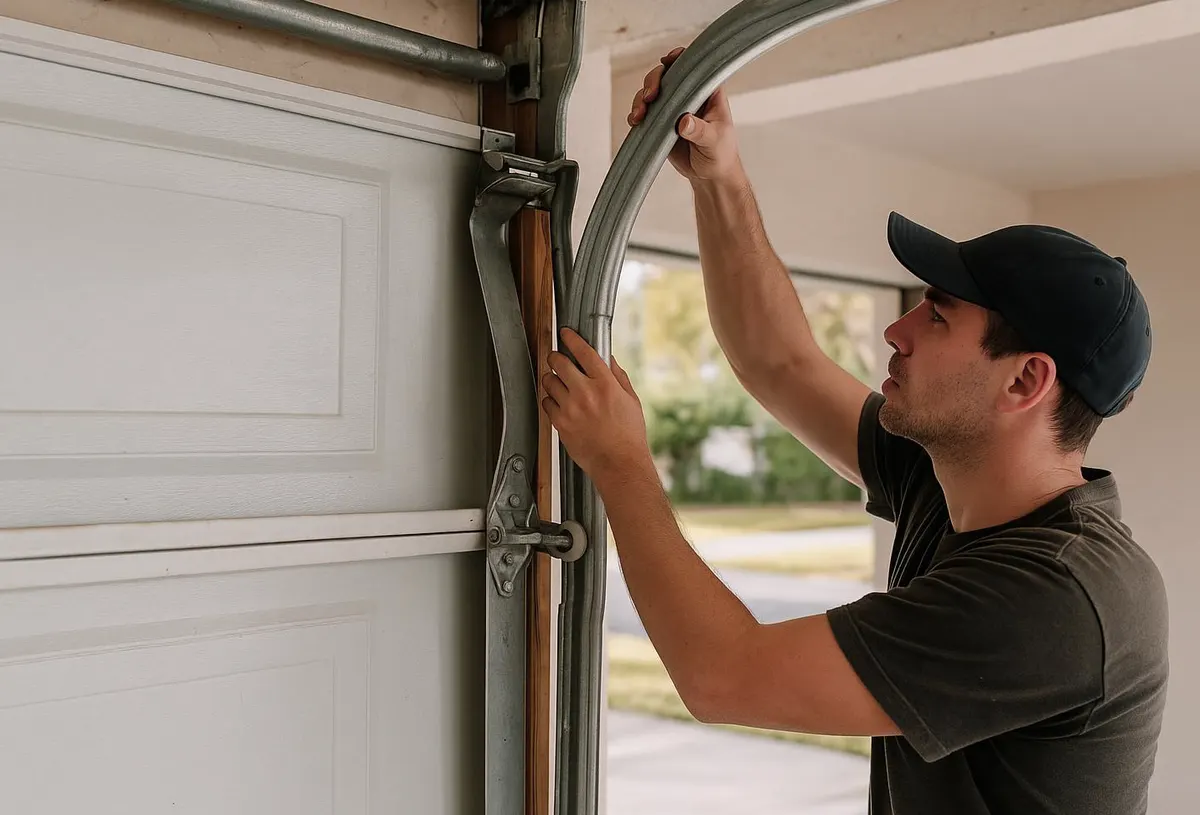
- No horizontal bracing on the back of the panels — many older doors, especially ones installed before wind-load codes tightened, were never built with reinforcement struts.
- An opener that's the only thing holding the door shut. Standard openers are not rated to resist wind pressure and were never designed to do that job.
What Actually Protects a Garage Door From Wind and Rain
Reinforcement Struts
Horizontal struts bolted to the back of each panel distribute wind pressure across the whole door instead of concentrating it on individual panels. This is one of the most cost-effective upgrades available for an existing door, generally running well under the cost of full replacement.
Wind-Rated Replacement Doors
If a door is older, thin-gauge, or already showing rust and flex, reinforcement has limits. A wind-load-rated door built for coastal wind speeds is a different product from a standard big-box door: heavier gauge steel, reinforced end stiles, and track hardware designed to handle both positive and negative pressure (wind pushing in and wind pulling out, which happens as a storm passes).
Track and Hardware Upgrades
Heavier tracks, reinforced roller brackets, and properly lagged vertical tracks matter as much as the panels themselves. A strong door on a weak track system still fails.
Weatherstripping and Bottom Seals
This won't stop wind failure, but with the afternoon downpours and wind-driven rain that come with tropical systems here, a worn bottom seal or side weatherstripping lets water intrude fast. Swelling from trapped moisture also warps wood-composite panels and accelerates rust on steel ones, so this is maintenance that protects the door's structural integrity, not just the garage floor.
Humidity and Rust Management
Between storms, the daily reality is heat and humidity. Lubricate rollers, hinges, and tracks on a regular schedule, and address surface rust before it spreads into the panel seams or structural ribs. Salt air near the coast makes this a faster-moving problem than it would be inland, so corrosion checks deserve more frequent attention than a once-a-year glance.
A Practical Pre-Storm Checklist
- Close the door and look for bowing, flex, or daylight gaps along the edges.
- Check every panel seam and the bottom corners for rust.
- Confirm the tracks are solidly lagged to framing, not just to drywall or trim.
- Look at the back of the panels for horizontal struts; if there are none, this is your first upgrade to price out.
- Test the bottom seal for cracking, gaps, or flattening.
- If the opener is the only thing keeping the door shut under pressure, that's a sign the door itself needs reinforcement or replacement, not a stronger opener.
When to Call Naples Garage & Gate
If you're seeing rust at the base, flex in the panels, or you simply don't know what your door's wind rating is (or if it has one), that's the point to call before a storm is on the forecast, not during one. Naples Garage & Gate can evaluate whether your existing door is a candidate for reinforcement struts and upgraded track hardware, or whether age, corrosion, or panel gauge mean a wind-rated garage door installation is the more durable fix. We also handle spring replacement and opener repair, since a door under wind load puts extra strain on both, and a failing spring or outdated opener can undercut even a well-reinforced door.
Storm season doesn't wait for a convenient time, and neither should this inspection. Call Naples Garage & Gate today to get your garage door evaluated and ready before the next system heads toward Naples, FL.